SARDIS
A downloadable game for Windows
Core Gameplay Loop
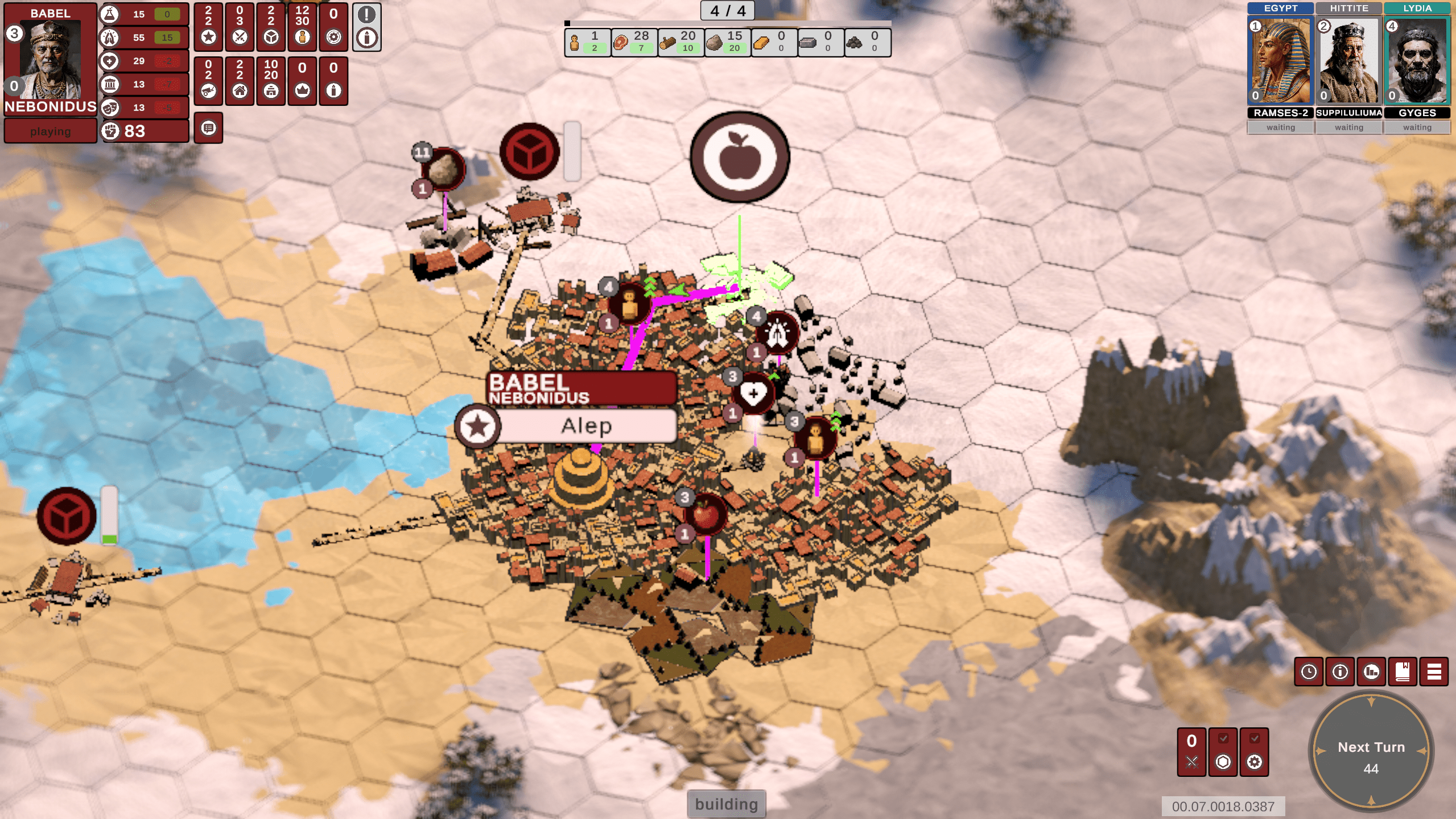
In this demo, you can play through the first two ages of SARDIS.
Each player has a certain amount of Turn Points. In the first age, players start with 4 Turn Points, which can be increased through various boosts. Once a player runs out of Turn Points, the turn passes to the next player.
Game Mechanics
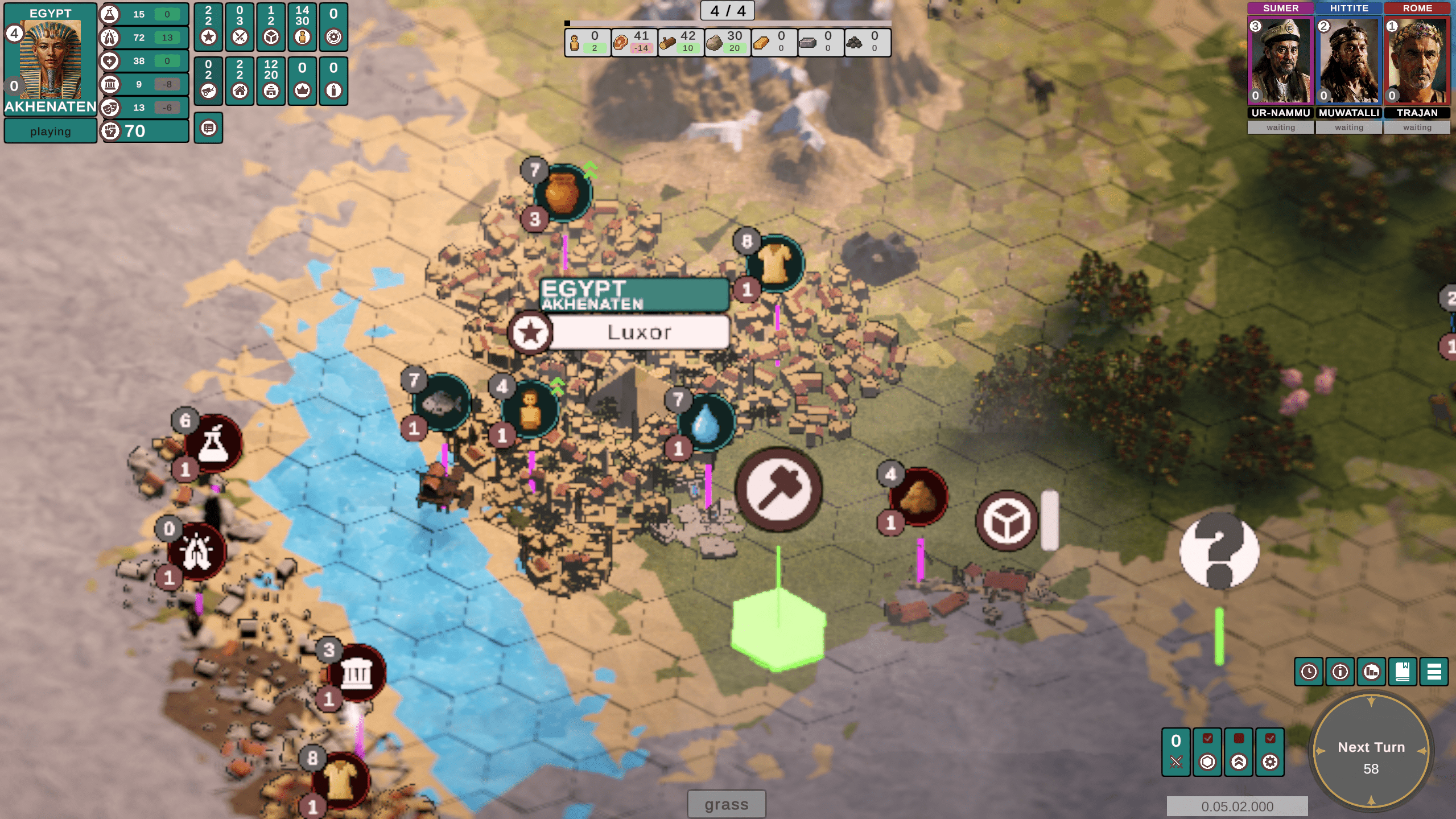
1. Production Chain
The game features a three-stage production chain:
- Raw Materials — resources produced directly from nature (meat, fish, wheat, wood, etc.)
- Intermediate Goods — materials processed in buildings to create final products (flour, needles, wool, thread, etc.)
- Finished Goods — final products, usually consumed by villagers or used as military equipment (clothes, jewelry, weapons, armor, etc.)
For example:
You grow wheat, process it into flour at a mill, then bake bread. Bread is one of the villagers’ basic needs.
Similarly, you can produce animal hides to craft armor or combine wood and stone to create spears. Then you use these items to train warriors.
The game also includes Intangible Resources, which provide Domination Points and also serve as direct needs for villagers. These are produced through special buildings, and each age requires different special buildings.
Intangible Resources include:
- Science
- Culture
- Entertainment
- Health
- Religion
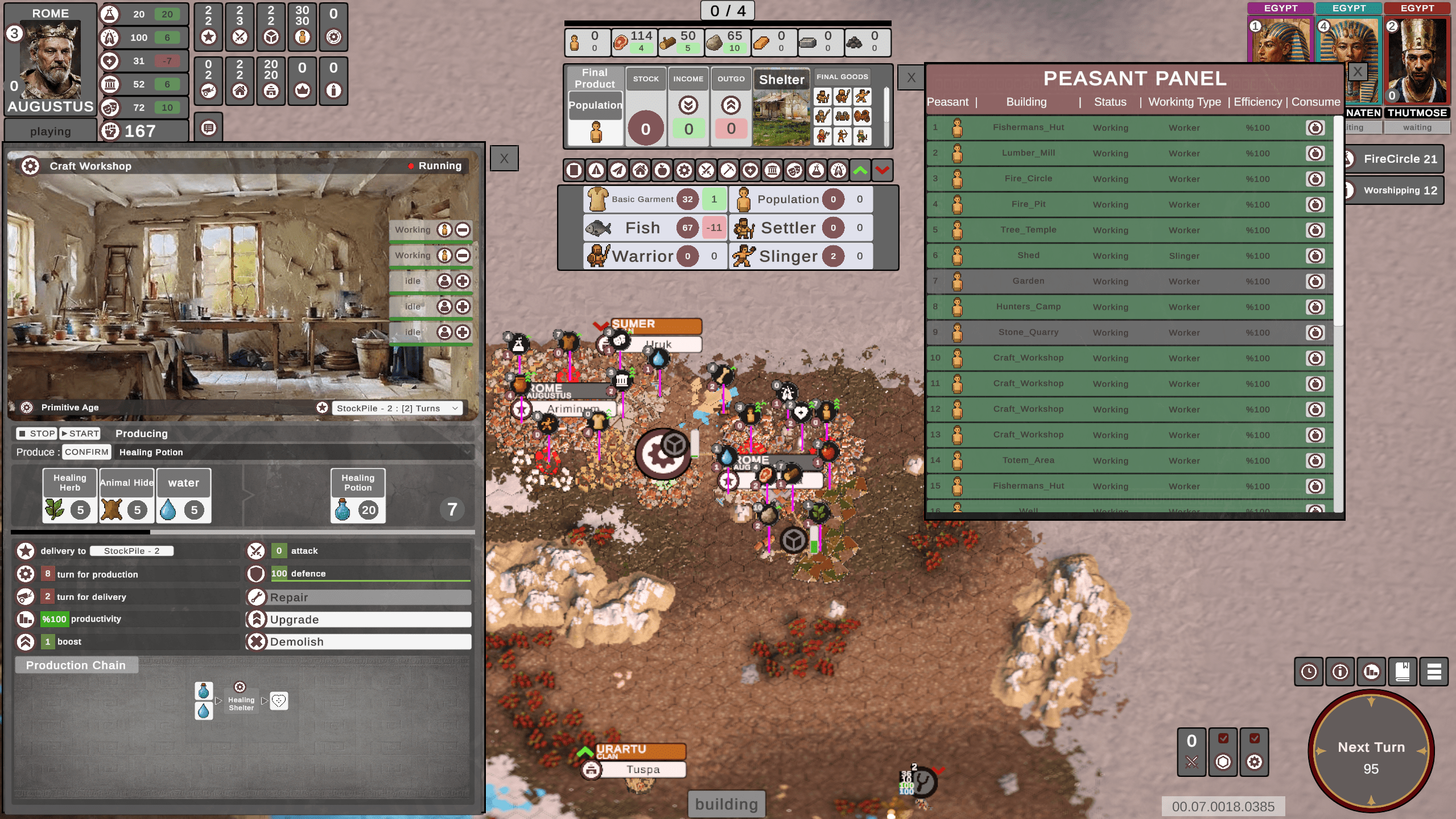
2. Building Production & Peasant Mechanics
Building production consists of two parts:
Production
Every building has a production time. To operate a building, you must assign villagers to it. Assigning more peasants reduces production time
Villagers also have needs. These needs become more diverse and demanding with each age. If their needs are not fulfilled, efficiency drops and production times increase.
Logistics
The second factor is the building’s hex-distance from the city center.
Produced goods must be transported back to the city center before they can enter storage and be used. Because of this, building placement becomes very important.
To optimize logistics, the game includes a Stockpile mechanic:
You can place stockpiles near production buildings and connect those buildings to the stockpile, greatly reducing production times.
However:
- Stockpiles have limited capacity.
- Once full, goods are transported to the city center in bulk.
- During this “Stockpile Emptying” phase, connected buildings stop producing until the stockpile is emptied.
- Each age also has a limit on how many stockpiles you can build, so you cannot place them everywhere.
Buildings can also be upgraded, increasing their production output. An upgraded building can produce up to twice as much output.
Additionally, buildings feature Adjacency Bonuses:
Certain adjacent buildings positively or negatively affect each other’s production.
For example:
- Science buildings boost production buildings positively.
- Heavy crafting buildings negatively affect housing and food buildings.
3. Technology System
The game contains 6 ages, each with its own technology tree.
You unlock technologies by spending Science Points over a number of turns.
Technologies mainly provide production bonuses.
For example:
Unlocking the “Clay Pot” technology in the first age might increase clay pot production by +10.
At the end of each age, there is an Age Point threshold.
When you reach it:
- You advance to the next age
- Gain various bonuses
- Unlock new buildings
- Earn Domination Points
4. Worshipping System
Each age has its own set of Worship Cards.
To unlock them, you need:
- A certain amount of Religion Points
- A required number of specific buildings
You can view these requirements from a list.
Example:
Suppose 10 villagers randomly follow a specific worship card. If all requirements are fulfilled and the card is activated, those 10 villagers may stop consuming resources for 50 turns.
All effects, durations, and requirements are visible directly on the card, allowing players to make strategic decisions based on their stock levels.
5. State Mechanics
States become available in the first age.
There are two government types:
City State
Focused on:
- Culture
- Science
Clan
Focused on:
- Religion
- Health
6. Governance System
Depending on the chosen State type, different government buildings become available.
These buildings allow players to convert one Intangible Resource into another.
Example:
By constructing the Council of Unity, you can spend 10 Health to generate 20 Culture.
Government buildings also provide additional bonuses such as:
- +1 City Capacity
- +1 Military Capacity etc.
7. Attitude System
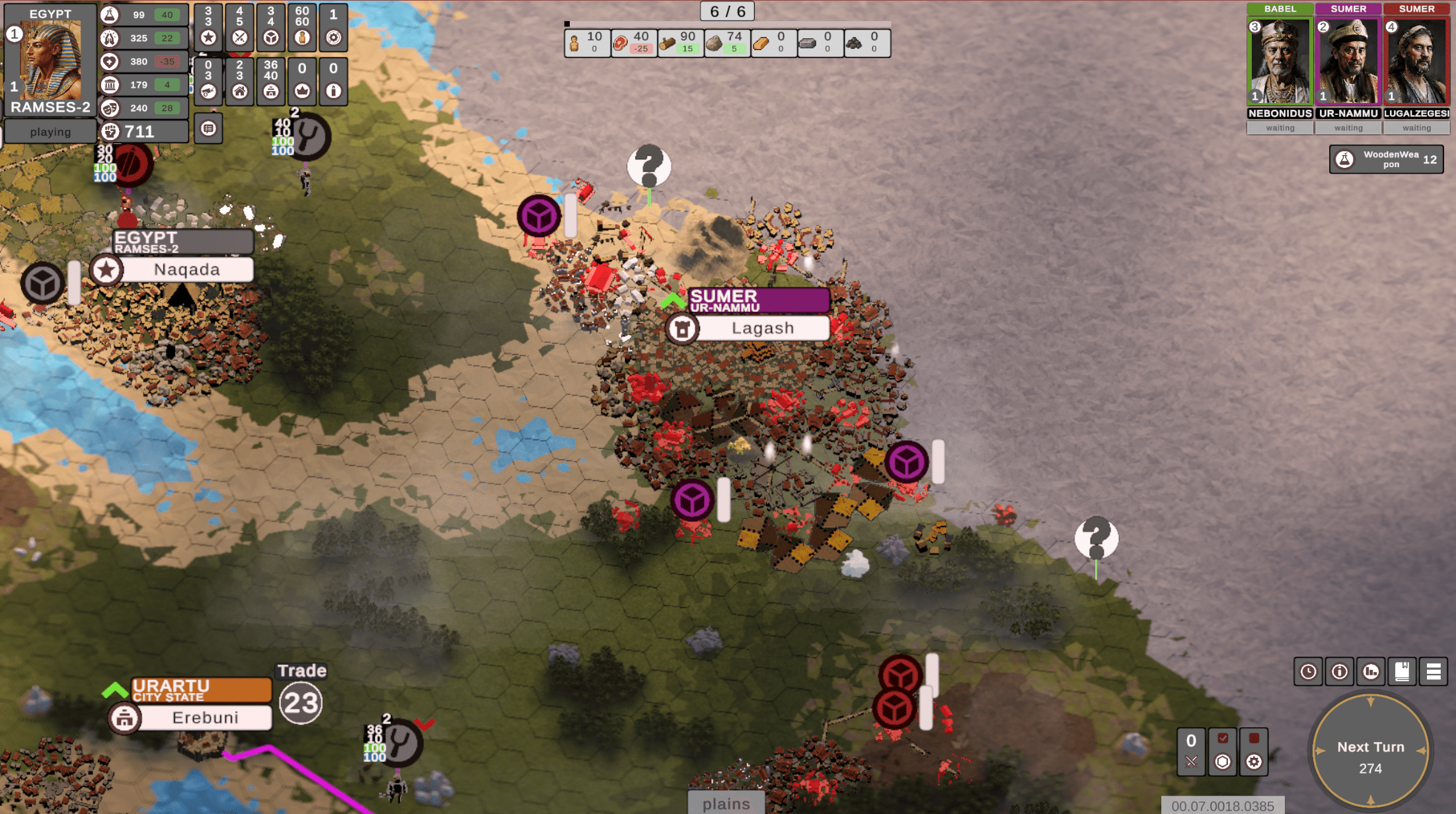
Every action you perform on the map affects how AI factions perceive you.
This Attitude score influences:
- Trade willingness
- Diplomatic behavior
- War declarations
Examples:
- Building too close to another faction decreases Attitude.
- Sending gifts or trading improves relations.
- Sharing the same State type or culture grants positive bonuses.
8. Domination Points
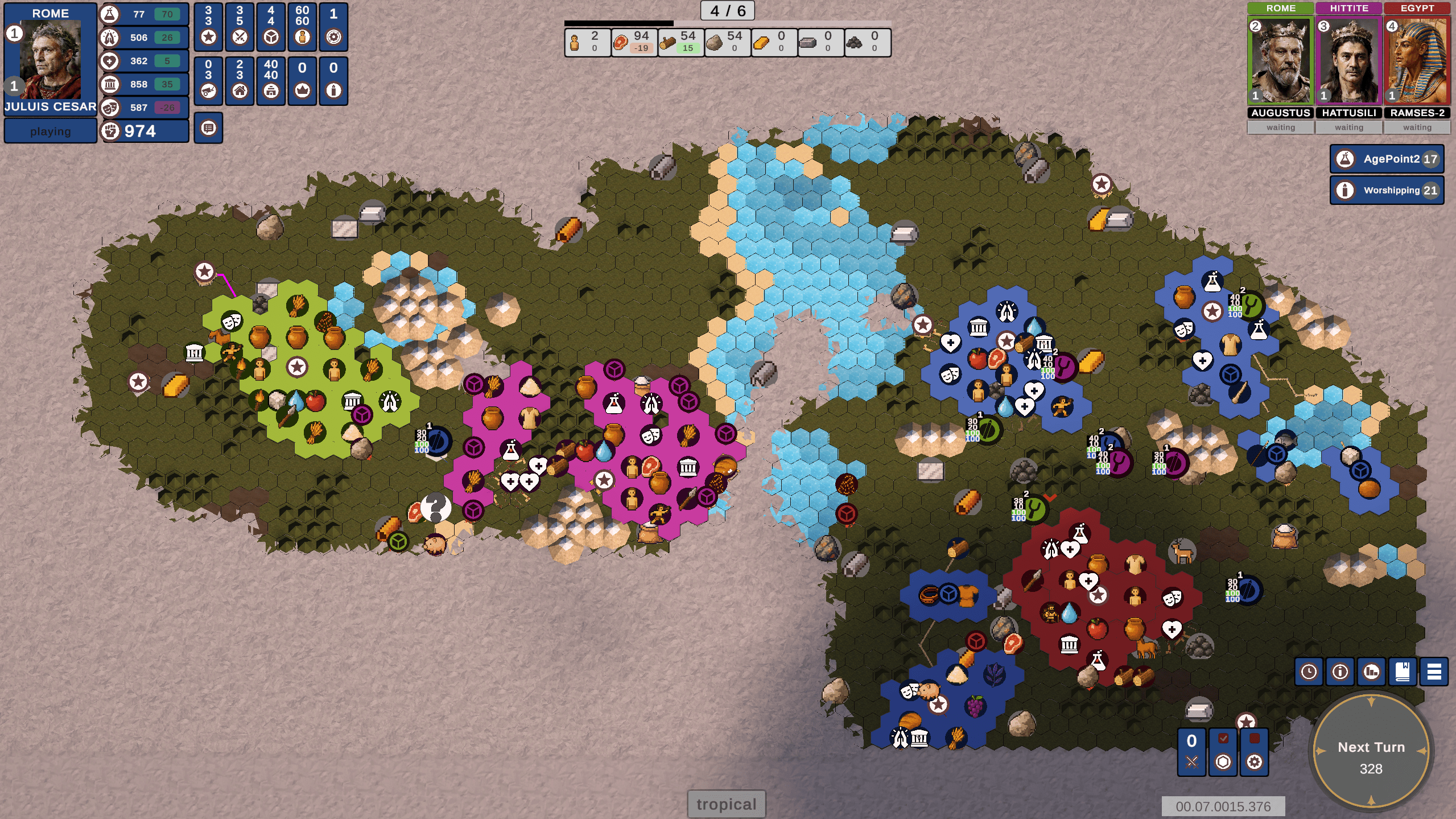
Domination Points are the primary victory score in the game.
You earn them through:
- Accumulating Intangible Resources
- Trading
- Winning wars
- Advancing through ages
However, if villagers’ needs are not met, you receive penalties that reduce your Domination Points
When the total turn limit ends, the player with the highest Domination score wins.
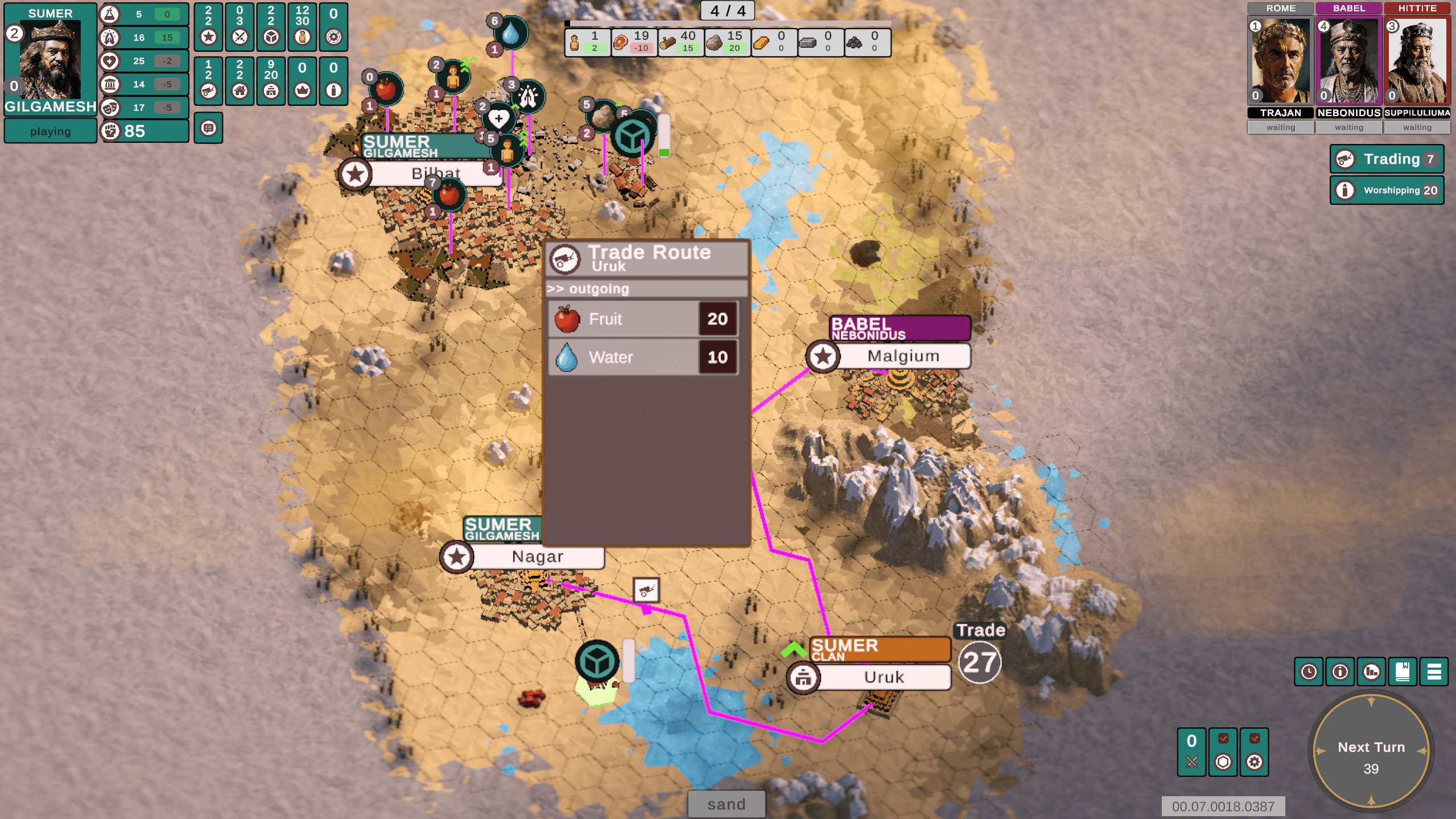
9. Diplomacy
Players and AI factions can send diplomatic actions to each other.
Main diplomatic actions include:
- Trade You may not have access to every resource on the map, so you must trade with rivals, free city-states, or clans to fill missing stockpiles. Trade works through direct stock exchange, and the AI evaluates offers based on its own inventory.
- Declare War Requires spending a certain amount of Domination Points.
- Peace Treaty Peace can be proposed depending on the course of the war.
- Send Gifts Used to improve relations.
- Send Agents If you lack certain goods, you can send agents to steal them from rivals
- Tribute Demand You can demand tribute from rivals, usually luxury goods such as gold, sapphires, or diamonds.
- Sanctions You can force rivals to stop specific productions for a number of turns
10. Exploration Mechanics
When units move onto question-mark locations on the map, they trigger exploration events.
These events provide random rewards and resources.
11. Warfare Mechanics
Each age contains standard trainable military units.
Additionally, every culture has unique special units, such as:
- Roman Legionaries
- Lydian Archers etc.
Core Combat Mechanics
Adjacency Bonus
Certain units boost each other when positioned side by side, increasing their Hit Points.
Tile Bonus
Some units receive penalties near certain terrain tiles.
Example:
Archers standing near Mud Tiles may receive a -5 penalty.
These bonuses and penalties are visible by clicking on the unit.
Morale
Every military unit is fundamentally a villager.
If that villager’s needs are not fulfilled, morale decreases, reducing combat effectiveness and Hit Points.
Because of this, declaring war while your population is unstable is risky.
Unit Stats
- Attack — offensive power
- Defense — defensive power
- Health — if it reaches 0, the unit dies
Buildings also have a default Defense value of 100.
When it reaches 0, the building is destroyed.
For example:
During war, you can destroy buildings on strategic resources and then occupy those locations yourself.
Download
Install instructions
After extracting the ZIP file, simply double-click SARDIS.exe to launch the game.
Leave a comment
Log in with itch.io to leave a comment.